
North Dakota NDDOT Permit Practice Test 27
- Questions25
- Correct to pass20
- Passing score80%
- Minimum age14 years
-
1. A driver in the left lane of a freeway realizes only when level with this sign that the ramp beside it is the one they need. What is the correct action?
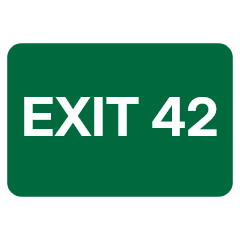
Show answer
Answer A: Carry on to the next interchange and turn back from there
There is no safe way back to a ramp once it has been reached from the wrong lane, so the driver keeps going to the next interchange, where the ramps are built for that movement.
-
2. You are behind a snow plow working on a highway. What is the correct way to drive?
Show answer
Answer C: Stay well back and do not try to pass it
A plow throws snow, runs wider than its body and works on the poor surface ahead of it, so the cleared road behind it is the safest place to be.
-
3. You are traveling at the same speed as a vehicle in the next lane, just behind its rear door. What should you do?
Show answer
Answer B: Change your speed so that you leave that driver's blind spot
That position is the classic blind spot. Slow slightly or move ahead so the other driver can see you before deciding to change lanes.
-
4. You realize you have driven several miles without remembering any of it. What kind of distraction is this?
Show answer
Answer C: Cognitive distraction, because your mind was not on driving
Daydreaming or being lost in thought is a cognitive distraction. Your eyes may be on the road, but your brain is not processing what they see.
-
5. You are clear of the tracks after your vehicle stalled on a crossing. Whom should you contact?
Show answer
Answer C: The emergency number posted on the blue sign at the crossing, or 911
Grade crossings carry an emergency notification sign with a railroad phone number and a crossing identification number so that approaching trains can be stopped, and 911 works if that sign is not visible.
-
6. How long does a parallel parking space need to be for the car you are driving?
Show answer
Answer D: About five or six feet longer than your vehicle
A few extra feet at each end give you the room to swing in and to straighten up without touching the vehicles in front or behind.
-
7. A flagger turns the paddle to the orange face reading SLOW. What does that tell approaching drivers?
Show answer
Answer D: Reduce speed and continue through the work area with care
The SLOW face keeps traffic moving at a reduced speed while workers or equipment are close to the travel lanes.
-
8. You are about to leave a roundabout when a pedestrian steps into the crosswalk on your exit. What should you do?
Show answer
Answer B: Yield to the pedestrian and wait for the crosswalk to clear
Roundabout crosswalks sit on the entries and exits, and drivers must yield to pedestrians using them.
-
9. You find yourself in a lane that must turn, you wanted to go straight, and you cannot change lanes safely. What should you do?
Show answer
Answer D: Make the required turn and find another route
Going straight from a mandatory turn lane surprises everyone around you, while a wrong turn costs only a few extra minutes.
-
10. You are in a marked passing zone but a steady stream of oncoming traffic is coming toward you. What does the broken center line allow?
Show answer
Answer C: A pass only when the road is clear, so you have to stay behind
A passing zone marks where the sight distance is adequate, but it never gives permission to enter a lane that another vehicle is occupying.
-
11. A signal stands part way up a freeway entrance ramp and turns green briefly again and again. How many vehicles does such a signal normally release on each green?
Show answer
Answer A: One for each lane of the ramp
A ramp control signal releases a single vehicle per lane on each green so that vehicles reach the merge one at a time instead of in a bunch.
-
12. What examination does North Dakota require for a motorized bicycle operator's permit?
Show answer
Answer B: A knowledge test and a vision screening, with no on-cycle skill test
An applicant for a motorized bicycle operator's permit passes the Class D noncommercial knowledge test and a vision screening, and no on-cycle skill test is required.
-
13. You make eye contact with a driver waiting to pull out of a side street. What should you assume?
Show answer
Answer D: The driver may still not have seen you, so stay ready to slow or stop
Drivers can look directly at you and still not register your vehicle, especially a small one. Eye contact helps, but never rely on it.
-
14. How much supervised practice driving must a North Dakota applicant under 16 complete?
Show answer
Answer D: A minimum of 50 hours in variable conditions
North Dakota requires applicants under 16 to complete at least 50 hours of supervised practice driving in variable conditions, in addition to formal driver education, and a parent or guardian must certify it on the day of the road test.
-
15. What happens after North Dakota cancels a minor's permit or license?
Show answer
Answer A: The driver is treated as never having held one and must start the whole process again
A cancelled minor is deemed never to have held a permit or license, so the knowledge test, the vision test, parental permission, a new instruction permit with its holding period and driver education must all be completed again.
-
16. You are joining a highway from a short ramp that has no acceleration lane. What should you do?
Show answer
Answer A: Stop or slow at the end of the ramp and wait for a safe gap
Without an acceleration lane there is no room to match speed, so you must yield at the end of the ramp and enter only when a gap allows it.
-
17. You realize your tires are running on ice. Which set of inputs is safest?
Show answer
Answer C: Gentle steering, no sudden braking, and no sudden acceleration
Whatever grip is left is used up at once by any sudden input, so every movement of wheel, brake and accelerator must be slow and small.
-
18. A black and white regulatory sign facing traffic at a divided section reads KEEP LEFT. What does it require?
Show answer
Answer D: Passing the island or obstruction on its left side
Keep Left is posted at an island or obstruction that traffic must pass on the left, which is the opposite of the far more common Keep Right situation.
-
19. A driver extends the left arm out the window and bends it upward at the elbow. What does this signal mean?
Show answer
Answer B: A right turn
The left arm bent upward at the elbow is the standard hand signal for a right turn.
-
20. A traffic signal ahead is showing a flashing red light. What does it require?
Show answer
Answer C: Stop completely, then go when the way is clear, as at a stop sign
A flashing red light has the same meaning as a stop sign: stop completely, yield to traffic and pedestrians, then proceed when it is safe.
-
21. On a two-lane road with a broken yellow center line, may you cross it to turn into a driveway on the left?
Show answer
Answer C: Yes, when it is safe and the oncoming lane is clear
A broken center line may be crossed for a pass or for a left turn into a road or a driveway, once the oncoming lane is clear.
-
22. A pedestrian using a white cane or walking with a guide dog starts to cross the street ahead of you. What must you do?
Show answer
Answer A: Yield and stay stopped until the person has finished crossing
A white cane or guide dog identifies a pedestrian who may not be able to see your vehicle, so you must yield and wait rather than maneuver around the person. The horn can confuse the pedestrian or the dog.
-
23. Loose gravel has been swept into the middle of your lane on a downhill bend. Which controls are affected most?
Show answer
Answer D: Steering and braking, since the loose stones roll under the tires
Gravel rolls between rubber and pavement, so the tires can neither turn the vehicle nor slow it as they would on a clean surface.
-
24. A curb sign reads 2 Hour Parking, 8 AM to 6 PM, Monday to Saturday. When may you stay longer than two hours?
Show answer
Answer A: Outside those hours and on Sundays
A time limit applies only during the days and hours printed on the sign; outside them the ordinary parking rules apply.
-
25. Why is dusk one of the harder times of day to drive?
Show answer
Answer B: The failing light blurs shapes into the background
In fading light there is not enough contrast to pick objects out, yet it is not dark enough for headlights to do the work, so pedestrians and cyclists disappear.