
North Dakota NDDOT Permit Practice Test 37
- Questions25
- Correct to pass20
- Passing score80%
- Minimum age14 years
-
1. A pedestrian with a white cane draws the cane back and steps away from the curb as you approach. What does that usually mean?
Show answer
Answer B: They are signaling you to go ahead and drive on
Pulling the cane in and stepping back from the curb is the customary way a blind pedestrian tells drivers to proceed.
-
2. How much clear road do driver manuals say you need before starting a pass at highway speed on a two-lane road?
Show answer
Answer C: Enough to complete the pass and return, roughly ten to twelve seconds of travel
At highway speed the whole maneuver of pulling out, overtaking and returning takes roughly ten to twelve seconds, and every foot of that has to be visible before you start.
-
3. A yellow diamond shows an arrow that doubles back on itself. What kind of curve lies ahead?
Show answer
Answer C: A turn of 135 degrees or more, nearly doubling back
The hairpin curve sign is used where the road changes direction by 135 degrees or more, and it is normally backed up by chevrons or a large arrow through the bend.
-
4. What is the correct relationship between air bags and seat belts?
Show answer
Answer B: Air bags are designed to work together with seat belts, not instead of them
An air bag is a supplemental restraint that cushions one impact, while the belt keeps you in position so the bag can work and protects you in rollovers and secondary impacts.
-
5. What does a sign reading Slower Traffic Keep Right require?
Show answer
Answer C: Traffic moving slower than the general flow must use the right-hand lane
The sign applies to any vehicle traveling below the speed of the traffic around it, which must keep right so faster vehicles can use the lanes to the left.
-
6. How long can cannabis affect a driver?
Show answer
Answer A: For hours after the strongest effects have passed
Slowed reactions, poor tracking and weak judgment of distance can last for hours, well beyond the point where the user believes the effects are over.
-
7. How should your speed behave while you move from one lane into the next?
Show answer
Answer C: Keep it steady or adjust it smoothly to match the traffic in the new lane
A lane change works best as a smooth movement at the speed of the lane you are joining, since sudden braking or acceleration surprises the drivers around you.
-
8. The circular sign shape is reserved for which warning?
Show answer
Answer C: Advance warning of a highway-rail grade crossing
A round yellow sign with a black X and the letters RR is the grade crossing advance warning sign, and the circular outline is used for no other message.
-
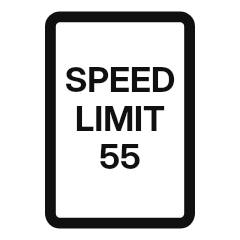
9. On a clear day with light traffic, a driver stays far below the maximum this sign sets. What can that cause?
Show answer
Answer B: Obstruction of the normal flow of traffic, which is prohibited in itself
Driving so slowly that other traffic is impeded is an offense in its own right when nothing about safety, weather or the road calls for it.
-
10. The electric windows will not work as your vehicle sinks in water. What is the best option?
Show answer
Answer C: Break a side window with a hard, pointed object and climb out through it
Side windows are tempered glass and can be broken, while the laminated windshield cannot, and water pressure holds the doors shut.
-
11. Blue pavement markings are used together with white markings at
Show answer
Answer D: parking spaces reserved for people with disabilities
Blue supplements the white markings of accessible parking spaces, which is the only assignment blue has on the pavement.
-
12. Which of these would appear as a symbol on a blue general service sign?
Show answer
Answer A: A hospital
General service signs cover facilities such as hospitals, fuel, food, lodging, camping, telephones and rest areas, all shown in white on blue.
-
13. When is a driver or rider most likely to need hand and arm signals instead of the vehicle turn signal lamps?
Show answer
Answer D: When the lamps have failed or cannot be seen because of glare or a load
Hand and arm signals replace or reinforce the lamps whenever the lamps do not work or cannot be seen clearly by other road users.
-
14. What should you do before leaving a parked vehicle unattended?
Show answer
Answer C: Set the parking brake, place the transmission in park or in gear, switch off the engine and take the key
Securing the vehicle with the parking brake, the transmission and the ignition prevents it from rolling away and from being moved by someone else.
-
15. A city transit bus at a stop ahead of you switches on its left signal. What should you do?
Show answer
Answer D: Slow and let the bus pull back into traffic
A bus needs a long gap to rejoin traffic, and yielding to a signaling transit bus keeps the whole line of traffic moving safely.
-
16. Why should the washer reservoir hold proper washer fluid rather than plain water in winter?
Show answer
Answer D: Water freezes and it leaves you with no way at all to clean the glass
Washer fluid contains antifreeze, so it still works in the cold, whereas water freezes in the reservoir and the lines.
-
17. You have a steady green ball to turn left, and the oncoming traffic gets a green left arrow. What does that mean for you?
Show answer
Answer C: Oncoming vehicles will turn across your path, so you must wait
A green ball is permissive, so when the oncoming side receives a protected arrow those vehicles have priority and you must yield until they clear.
-
18. You are approaching a horse and rider on a country road. What about your horn?
Show answer
Answer C: Do not sound it at all, because the noise can frighten the animal
A startled horse is dangerous to its rider and to you, so pass wide and slow and leave the horn alone.
-
19. You are turning left from a two-way street onto another two-way street. Where should you begin and end the turn?
Show answer
Answer B: Begin in the lane just right of the center line and finish just right of the center line of the new street
You approach a left turn from the lane closest to the center line and enter the new roadway just to the right of its center line, which keeps you clear of oncoming traffic.
-
20. You are driving on a divided highway and see a solid yellow line along the left side of your lanes. What does it tell you?
Show answer
Answer D: It marks the left edge of the roadway for your direction
On a divided highway or a one-way roadway, the left edge of the traveled way is marked with a solid yellow line.
-
21. Why is repeatedly changing lanes to work through heavy traffic a poor idea?
Show answer
Answer A: It raises the crash risk and saves almost no time
Each lane change adds a conflict with another vehicle, and in congestion the lanes move at similar average speeds, so the gain is negligible.
-
22. In a vehicle with automatic transmission, which foot should operate the brake and accelerator?
Show answer
Answer D: The right foot for both pedals
Using only the right foot prevents pressing both pedals at once and keeps the response the same in every vehicle you drive. The left foot rests on the floor or the footrest.
-
23. You are approaching a refuse collection truck working along your street. What should you expect?
Show answer
Answer D: Workers stepping into the road around the truck
Collection crews move constantly between the truck and the curb, often from where you cannot see them, so slow right down and pass only when the whole area is clear.
-
24. Something rolls off the seat onto the floor while you are driving. What should you do?
Show answer
Answer C: Leave it where it is and pick it up after you stop somewhere safe
Reaching for an object pulls your eyes and your body away from the controls at exactly the wrong moment, and nothing on the floor is worth that risk.
-
25. Why is hard braking the wrong response to a tire blowout at speed?
Show answer
Answer C: Because it can pull the vehicle further out of line and start it spinning
With one tire gone the braking forces are uneven, so heavy braking increases the pull to one side and can spin the vehicle.