
North Dakota NDDOT Permit Practice Test 40
- Questions25
- Correct to pass20
- Passing score80%
- Minimum age14 years
-
1. In most states, when are headlights required apart from times of poor visibility?
Show answer
Answer A: From about half an hour after sunset to half an hour before sunrise
Most states require lights from about half an hour after sunset until about half an hour before sunrise, and some simply say sunset to sunrise; lights are also required whenever visibility is poor.
-
2. Which shape is used for the school advance warning sign and the school crossing sign?
Show answer
Answer B: An upward-pointing pentagon
The five-sided pentagon with its point up identifies school signing, so the outline alone tells a driver that children may be present.
-
3. You are stopped at a stop sign where your road ends at a two-way through street and you plan to turn left. What must you yield to?
Show answer
Answer B: Traffic from both directions and any pedestrians crossing
A left turn from the stem of a T crosses the near lane and joins the far one, so you give way to traffic in both directions and to pedestrians.
-
4. You are entering a marked work zone. What should you expect?
Show answer
Answer B: A reduced posted speed, narrowed or shifted lanes, and traffic that may stop suddenly
Work zones change the geometry of the road and can bring traffic to a halt without warning, so the posted work zone speed and increased following distance both apply.
-
5. You park in your own driveway and the rear of the vehicle sticks out over the sidewalk. What is wrong with that?
Show answer
Answer C: It blocks the sidewalk and forces people into the street
A vehicle overhanging the sidewalk pushes pedestrians, wheelchair users and strollers into the roadway, and blocking a sidewalk is prohibited.
-
6. Why should you not rest your foot on the brake pedal as you drive?
Show answer
Answer D: The brake lights stay on and the drivers behind cannot read you
Resting on the pedal keeps the brake lights lit and wears the brakes, so following drivers stop believing your brake lights.
-
7. It is dark, it is raining and you are towing a trailer. How should you set your following gap?
Show answer
Answer B: Add extra seconds for each condition, well beyond three
Each factor that lengthens your stopping distance or shortens your view calls for another second or more, and they add up when several occur together.
-
8. On a long, straight highway you feel your attention fading. What helps you stay alert?
Show answer
Answer A: Keep your eyes moving, scan mirrors and signs, and take regular breaks
Staring at one point brings on highway hypnosis. Active scanning keeps the mind engaged, and a break every couple of hours restores alertness.
-
9. Why is a sign reading BRIDGE ICES BEFORE ROAD worth heeding even when the road itself is merely wet?
Show answer
Answer C: Cold air passes under a bridge as well as over it
A bridge deck loses heat from below as well as above, so it can be frozen while the road on either side of it is only wet.
-
10. A truck passes you in heavy rain and its spray blanks out your windshield. What should you do?
Show answer
Answer B: Hold the wheel steady, ease off slightly and let the wipers clear it
The blackout lasts a second or two. Keeping your line and easing off is far safer than braking hard or steering blind toward the shoulder.
-
11. You are already inside an intersection when you realize you should be in the lane beside you. What should you do?
Show answer
Answer C: Stay in your lane through the intersection and change lanes afterwards
Drivers in an intersection are watching for cross traffic and turning vehicles, so an unexpected sideways move there is easily missed.
-
12. You reach an uncontrolled intersection at the same moment as a vehicle approaching from your left. What should you do?
Show answer
Answer A: Proceed, but only once you see that driver slowing
You have the right of way over the vehicle on your left, but a right of way is something the other driver has to give, so confirm it before you commit.
-
13. A pedestrian waiting at a curb faces a steady upraised hand. What does that indication mean?
Show answer
Answer A: Do not start to cross in that direction
A steady upraised hand forbids entering the crosswalk, while a flashing hand only forbids starting a new crossing.
-
14. You are about to make a three-point turn on a narrow two-way street. What is the first step?
Show answer
Answer B: Pull close to the right edge, signal left and check traffic both ways
A three-point turn starts from a stop at the right edge with a left signal, and you only move once you have checked that both directions are clear.
-
15. A high-occupancy vehicle lane is separated from the general lanes by a pair of solid white lines with a gap every so often. Where may you enter or leave it?
Show answer
Answer D: Only at the openings where the solid lines are broken
The solid lines forbid crossing, so entry and exit are limited to the designated openings where the marking is broken.
-
16. A sign beside the signal reads STOP HERE ON RED. What does it tell you?
Show answer
Answer B: Stop at that point on red, not closer to the intersection
The sign marks the required stopping point, which is set back from the corner so that turning vehicles and sight lines are not blocked.
-
17. When are the hazard warning lights properly used?
Show answer
Answer A: When your vehicle is stopped or barely moving and is a hazard
Hazard lights warn that your vehicle is an obstruction; they do not authorize illegal parking and they hide your turn signals while driving.
-
18. You are passing a large truck on an open highway in a strong crosswind. What should you expect?
Show answer
Answer A: A push toward the truck, then a push the other way as you clear it
The truck shelters you as you go by and then releases you into the full gust, so the load on the steering changes twice during the pass.
-
19. You are turning left at an intersection just beyond the crest of a hill. What is the added risk?
Show answer
Answer B: Oncoming vehicles appear with very little warning and close quickly
A crest hides approaching traffic until it is close, so the gap you thought was empty can fill in the time the turn takes.
-
20. You signaled a lane change and the signal did not switch itself off afterwards. Why does that matter?
Show answer
Answer B: Other drivers may act on a turn you do not intend to make
A signal left on tells other drivers you are about to turn, and someone may pull out in front of you. Cancel it as soon as the maneuver is finished.
-
21. What imprisonment does North Dakota require for a second driving under the influence conviction within seven years?
Show answer
Answer A: At least ten days, of which 48 hours must be served consecutively
A second offense within seven years brings at least ten days imprisonment with 48 hours served consecutively, a $1,500 fine and 360 days in the 24/7 sobriety program.
-
22. You are making a legal U-turn at an intersection. Who has the right of way?
Show answer
Answer C: Everyone else, until your turn is complete
A U-turn crosses several paths at once, so you yield to oncoming vehicles, to crossing traffic and to pedestrians before starting it.
-
23. A driver sees this sign on a quiet road with no other traffic in either direction. What is the correct response?
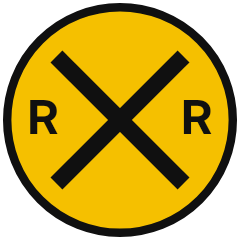
Show answer
Answer C: Slow down, look and listen for a train, and be ready to stop
The sign gives advance notice of a highway-rail grade crossing, so the driver reduces speed, checks both directions along the tracks and keeps enough room to stop short of the rails.
-
24. Beside an accessible parking space there is an area painted with diagonal stripes. What is it for?
Show answer
Answer C: It is an access aisle for wheelchairs and lifts, and no vehicle may park or stop in it
The striped access aisle gives the room a ramp or lift needs to deploy, so blocking it makes the adjacent accessible space unusable.
-
25. You have just passed a large truck on the freeway. Why is it dangerous to pull back in front of it and then brake for your exit?
Show answer
Answer B: A loaded truck needs much more distance to stop than a car
A fully loaded tractor-trailer can need the length of a football field or more to stop from highway speed. Cutting in and braking leaves the driver no room to avoid hitting you.