
North Dakota NDDOT Motorcycle Practice Test 19
- Questions25
- Correct to pass20
- Passing score80%
- Minimum age14 years
-
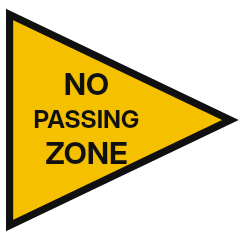
1. Where does the restriction that starts at this sign come to an end?
Show answer
Answer D: Where the centerline markings show that overtaking is allowed again
The sign marks the start of the restricted section, and the centerline markings along the road show how far it runs and where overtaking becomes lawful again.
-
2. What should a passenger be told about moving around on the motorcycle?
Show answer
Answer A: To stay directly behind the operator and avoid sudden or unnecessary movement
Unexpected movement by a passenger upsets the balance of the machine, most of all at low speed and while the motorcycle is leaned over in a turn.
-
3. A driver hunting for an on-ramp meets this sign at the mouth of the pavement ahead. What is the correct action?

Show answer
Answer C: Keep out of that roadway and look for the proper approach elsewhere
The restriction is absolute and does not depend on how much traffic is present, so the driver has to reach the highway by an approach built for entering vehicles.
-
4. You are driving in the left lane at the posted speed limit and a line of vehicles has built up behind you. What should you do?
Show answer
Answer D: Move into a lane on your right when it is safe and let the traffic behind go by
Most states require traffic moving slower than the flow to keep right and reserve the left lane for passing, so a driver holding up a line of vehicles should move right when it is safe rather than block the lane.
-
5. The leader of a group wants to pull the whole group out from a side road into busy traffic. What should the leader do?
Show answer
Answer B: Wait for a gap long enough for every rider in the group to enter
A leader who takes a gap that only fits one machine leaves the rest of the group either stranded or tempted to pull out in front of traffic.
-
6. Which of these would appear as a symbol on a blue general service sign?
Show answer
Answer A: A hospital
General service signs cover facilities such as hospitals, fuel, food, lodging, camping, telephones and rest areas, all shown in white on blue.
-
7. You have just ridden over a large object lying in the road. What should you do next?
Show answer
Answer A: Pull over when it is safe and check the tires and rims for damage
An impact can cut a tire, dent a rim or bend a fork without giving any immediate change in how the machine feels, so it deserves a look.
-
8. A steady downward green arrow is displayed over a lane. What does it indicate?
Show answer
Answer C: The lane is open to traffic in your direction
A steady downward green arrow means the lane it points to is open to traffic traveling in your direction.
-
9. You are making a legal U-turn at an intersection. Who has the right of way?
Show answer
Answer C: Everyone else, until your turn is complete
A U-turn crosses several paths at once, so you yield to oncoming vehicles, to crossing traffic and to pedestrians before starting it.
-
10. A yellow diamond shows an arrow that doubles back on itself. What kind of curve lies ahead?
Show answer
Answer C: A turn of 135 degrees or more, nearly doubling back
The hairpin curve sign is used where the road changes direction by 135 degrees or more, and it is normally backed up by chevrons or a large arrow through the bend.
-
11. Why is it useful to watch the vehicle two or three places ahead of you?
Show answer
Answer C: You get an earlier warning of slowing traffic than brake lights give
Trouble travels back through a line of traffic, so seeing it start several vehicles ahead gives you a head start on braking.
-
12. Why do experienced riders cover the clutch lever and the brake lever in heavy traffic?
Show answer
Answer B: It shortens the time needed to react if they suddenly have to stop
With fingers already resting on the levers the rider skips the time it takes to reach for them, which shortens overall stopping distance.
-
13. What should motorcycle footwear provide?
Show answer
Answer B: Sturdy support above the ankle with hard, slip resistant soles
Boots that cover the ankle support and protect it, while hard slip resistant soles keep the rider steady at stops, and laces should be tucked in so they cannot catch.
-
14. Where should a passenger sit on the motorcycle?
Show answer
Answer A: As far forward as possible without crowding the operator
Sitting well forward keeps the passenger weight close to the center of the motorcycle, which helps it handle closer to normal.
-
15. An oncoming vehicle keeps its high beam on and dazzles you. What should you do?
Show answer
Answer C: Look toward the right edge of your lane and slow until it has passed
Shifting your gaze to the right edge of the lane keeps you on line without staring into the glare, and slowing gives you time if something is hidden in it.
-
16. Why should gloves and jacket sleeves overlap?
Show answer
Answer A: So no gap of bare skin is left at the wrist in a slide or the cold
The wrist is easy to leave exposed, and a gap there lets in cold air and takes the full force of a slide, so gauntlets or elastic cuffs should close the gap.
-
17. What does a light drag of the rear brake do during a slow, tight turn?
Show answer
Answer C: It steadies the motorcycle and smooths out the power reaching the rear wheel
Working the rear brake against a slipping clutch takes the jerkiness out of the drivetrain and holds the machine steady through the turn.
-
18. Visibility drops suddenly and you decide to leave the highway. What is the safest way to do it?
Show answer
Answer A: Take the next exit or a wide pull off, well clear of the traffic lanes
Get right off the traveled way, and off the shoulder too if you can, because vehicles in poor visibility often drift onto the shoulder.
-
19. You are entering a freeway using an on-ramp with an acceleration lane. What is the correct technique?
Show answer
Answer C: Use the acceleration lane to reach the speed of traffic, then merge into a gap while yielding to traffic already on the freeway
The acceleration lane exists so you can match the speed of freeway traffic before merging, and drivers already on the freeway have the right-of-way.
-
20. Before pulling out to pass on a two lane road, which lane position gives the best view of the road ahead?
Show answer
Answer B: The left portion of your lane
Moving to the left of your own lane lets you see past the vehicle ahead and judge the oncoming lane before committing any part of the machine to it.
-
21. What should you do with the key and your belongings when you leave the vehicle in a public lot?
Show answer
Answer D: Take the key with you, lock up and put valuables out of sight
Most vehicle thefts are opportunistic: a key left behind or a bag in plain view is the invitation.
-
22. Which set of qualities should eye protection for riding have?
Show answer
Answer A: Shatter resistant, free of scratches, and sealed against the wind
Riding eye protection has to survive an impact, let you see clearly and keep the air out, which is why plastic face shields and goggles are used instead of ordinary glasses.
-
23. After turning right you see a sign showing that your lane ends a short way ahead. What should you do?
Show answer
Answer B: Signal and merge into the next lane while there is still room
Merge early and smoothly while a gap is still available, rather than running out of pavement or forcing your way in at the last moment.
-
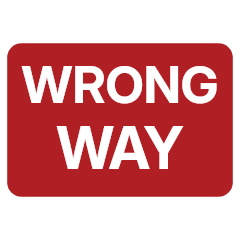
24. This sign comes into view ahead of a driver who has already started along a ramp. What should the driver do?
Show answer
Answer B: Pull clear where it is safe, then turn around and leave the ramp traveling properly
The driver is traveling against the legal flow, so the safest response is to stop clear of the lanes, turn the vehicle around and get off the ramp before meeting traffic head on.
-
25. How do stimulant drugs such as amphetamines or cocaine typically affect driving?
Show answer
Answer D: They can make the driver overconfident and more willing to take risks
Stimulants create a false sense of alertness and encourage aggressive, risky driving. When they wear off, sudden fatigue can follow.