
North Dakota NDDOT Motorcycle Practice Test 3
- Questions25
- Correct to pass20
- Passing score80%
- Minimum age14 years
-
1. A sign warns that the right lane ends ahead, and traffic is still flowing freely. What should you do if you are in that lane?
Show answer
Answer C: Signal, adjust your speed and move left in good time before the lane ends
When traffic is moving freely there is room to merge early and smoothly, which avoids the last-second lane change at the closure point.
-
2. Four vehicles reach a four-way stop from all four directions at the same instant. How is the deadlock resolved?
Show answer
Answer C: Each driver yields to the vehicle on the right and they go one by one
Yielding to the right applies to every driver, so the group untangles itself as drivers take turns rather than moving together.
-
3. What happens when tires are driven underinflated for a long time?
Show answer
Answer D: They wear at the edges, they run hot and they are more likely to fail
An underinflated tire flexes too much, which wears the shoulders and builds up heat that can destroy the tire.
-
4. A school sign paired with a plaque showing a diagonal downward-pointing arrow is installed
Show answer
Answer D: at the school crossing itself, or as close to it as possible
The diagonal downward arrow points at the crossing, so this assembly is placed at the crossing location rather than in advance of it.
-
5. You are about to carry a passenger for the first time. Where should you begin?
Show answer
Answer C: In a quiet area away from traffic, at low speed
A passenger changes balance, braking and steering feel, and those differences are best learned somewhere there is nothing else to deal with.
-
6. You come to a place where a storm has dropped a power line across the road ahead. What should you do?
Show answer
Answer B: Stop well back, keep everyone away from it and report it to the police
A downed line may be live and can energize the ground around it, so keep well clear and let the utility or the police handle it.
-
7. Which feature matters most in clothing meant to keep a rider warm?
Show answer
Answer C: A windproof outer layer, since moving air strips body heat fast
Wind blowing through clothing carries away heat faster than anything else, so a windproof outer shell over insulating layers is what keeps a rider warm.
-
8. What is the correct swerving technique?
Show answer
Answer D: Press the handgrip on the side you want to go and look toward the escape route
A swerve is two quick countersteering inputs, and because the motorcycle goes where the rider looks, the eyes belong on the open space.
-
9. You have turned onto a street and see parked cars facing you and headlights coming toward you. What has probably happened?
Show answer
Answer C: You have turned the wrong way onto a one-way street
Vehicles parked facing you and headlights approaching in your lane are the classic signs of driving against the flow on a one-way street.
-
10. A disabled vehicle is blocking your lane on a two-lane road with a single solid yellow line on your side. What should you do?
Show answer
Answer C: Wait until the oncoming lane is clear, then go around carefully
The solid line prohibits overtaking a moving vehicle, but in most states a driver may go around an obstruction such as a disabled vehicle once the oncoming lane is clear and the move can be made safely.
-
11. What is the correct order of actions when passing a vehicle on a two lane road?
Show answer
Answer D: Signal, check the mirrors and blind spot, pass in the left lane, signal and return
The rider signals and checks behind before moving out, completes the pass in the passing lane, then signals and checks again before returning.
-
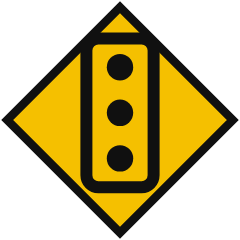
12. A driver passes this sign and the signal beyond it is already showing green. What is the safest response?
Show answer
Answer C: Ease off the accelerator and be ready to stop, because an indication that has been showing for a while is about to change
A signal that has been displaying the same indication for some time is close to changing, so arriving at a controlled speed with the brake covered is safer than accelerating to beat it.
-
13. You are following closely behind a vehicle you intend to pass on a two-lane road. What should you do first?
Show answer
Answer D: Drop back to give yourself room to build speed before you pull out
From close behind you cannot see far enough ahead and you have no room to gather speed, so the pass takes longer and starts blind.
-
14. What happens to a motorcycle's ground clearance when a passenger is carried?
Show answer
Answer A: It is reduced, so parts touch down at a smaller lean angle
The extra load compresses the suspension and lowers the machine, so footrests and other parts can drag on the road sooner in a turn.
-
15. You are approaching an intersection in a line of traffic. What can you do to be more visible to a driver waiting to pull out?
Show answer
Answer D: Move to a lane position where you are not hidden behind the vehicle ahead
A motorcycle tucked directly behind a larger vehicle is invisible to a waiting driver until the moment it appears, so the rider moves to where the headlight can be seen.
-
16. You have stopped on the shoulder of a highway and want to rejoin the traffic. What is the correct way?
Show answer
Answer D: Signal, build up speed along the shoulder, then merge into a gap
Entering a fast lane at a slow speed is what causes the conflict, so the shoulder is used to gain speed before the merge in the same way as an acceleration lane.
-
17. What do the letters in the SEE riding strategy stand for?
Show answer
Answer B: Search, Evaluate, Execute
Riders search for hazards, evaluate how those hazards could interact, and execute a plan by adjusting speed, position or communication.
-
18. A bike lane on your right is marked with a dashed line for the last stretch before the corner. What does that dashed section allow you to do?
Show answer
Answer D: Merge into the bike lane after checking, and turn right from there
The dashed section is where drivers are meant to merge into the bike lane before turning, which puts cyclists behind the vehicle instead of beside it.
-
19. Which helmet style gives the rider the most coverage?
Show answer
Answer C: A full face helmet
A full face helmet covers the chin and jaw as well as the skull, protecting the area that open styles leave exposed.
-
20. On traffic control devices, the color green shows direction to a destination and also shows
Show answer
Answer C: that a movement is permitted
Green carries two assignments: guidance toward destinations, and the idea that the movement shown is allowed, as on a green arrow.
-
21. Why is it harder for a rider to judge distance and closing speed after dark?
Show answer
Answer D: Only lights are visible, so closing speeds are hard to read
At night you see lights rather than whole vehicles and the scene around them, which strips away the cues that tell you how far away something is and how fast it is closing.
-
22. The vehicle you have borrowed is larger and heavier than your own. How should you drive it?
Show answer
Answer B: Allow more room for stopping and for turns until you are used to it
Extra weight and length mean longer stopping distances and wider turns, so give yourself more room until you are used to it.
-
23. What is the right speed for a normal right turn at a city corner?
Show answer
Answer C: Slow enough to hold your lane and stop for a pedestrian
A city right turn is tight and crosses a crosswalk, so the correct speed is one that keeps you inside your lane and still allows a stop.
-
24. Cones and drums mark a shifted lane through a work zone. What should you do?
Show answer
Answer A: Follow the path that they mark and stay inside it
Channelizing devices define the temporary travel path, and the space on the other side of them belongs to the workers.
-
25. The street you are turning right onto has a bike lane along its right edge. Where should your vehicle end up?
Show answer
Answer B: In the first traffic lane to the left of the bike lane
A bike lane is not a travel lane for motor vehicles, so the nearest lane you may finish a right turn in is the first general traffic lane beside it.