
North Dakota NDDOT Motorcycle Practice Test 34
- Questions25
- Correct to pass20
- Passing score80%
- Minimum age14 years
-
1. An overhead lane-use control signal shows a steady red X above your lane. What does it mean?
Show answer
Answer B: You may not use that lane and must move out of it
A steady red X means the lane below it is closed to you, while a steady yellow X is the warning to prepare to vacate the lane and a downward green arrow means the lane is open.
-
2. Two solid white lines separate your lane from the lane beside it. What do they mean?
Show answer
Answer B: Crossing from one lane to the other is prohibited
A solid double white line marks a boundary that road users may not cross, such as the entrance to a preferential lane.
-
3. Which item does most to keep a rider comfortable in cold weather beyond a jacket and gloves?
Show answer
Answer B: A close fitting neck cover that stops air entering at the collar
Cold air funnelled in at the neck chills the whole body, so a snug neck tube or balaclava makes a large difference, while a loose scarf is a hazard because it can catch.
-
4. A North Dakota driver is cited for no insurance although the policy was in fact in force. What can prevent a finding of violation?
Show answer
Answer B: Producing satisfactory evidence of the policy to the prosecutor before the matter is decided
A driver who produces satisfactory evidence to the prosecutor of a valid policy in effect at the time of the alleged violation may not be found in violation of the section.
-
5. You are stopped in traffic at a red light when an ambulance comes up behind you with its siren on. What is the correct action?
Show answer
Answer D: Stay put until you can move aside legally and safely
You must not run a red light or make an unsafe move to yield; wait, then pull to the side once the way ahead lets you do it safely.
-
6. How does North Dakota classify a first offense of driving while a license is suspended or revoked?
Show answer
Answer C: A class B misdemeanor
Driving while suspended or revoked is a class B misdemeanor for the first, second or third offense within a five-year period, rising to a class A misdemeanor for any later offense in that period.
-
7. What does a pre-ride check of a hydraulic brake system cover?
Show answer
Answer C: The fluid level and any sign of a leak at the hoses and fittings
A falling fluid level means either worn pads or a leak, and a leaking hose or fitting can empty the system without warning.
-
8. For an alert driver, about how long is the reaction time once a hazard has been recognized?
Show answer
Answer A: About three quarters of a second
Reaction alone takes roughly three quarters of a second for an alert driver, and perception takes about as long again, so a second and a half of travel is added before the brakes bite.
-
9. A line of short dashes set closer together than an ordinary lane line runs beside your lane where a ramp leaves the highway. What does a dotted line of that kind convey?
Show answer
Answer A: A warning that the lane is about to change function
Dotted lines give guidance or warning about a downstream change, such as a lane that becomes an exit only lane or a lane line carried across an intersection.
-
10. On a rainy road, where can a rider usually find the best traction?
Show answer
Answer A: In the tire tracks left by the vehicles ahead
Vehicles ahead push water aside and keep their tracks clearer of oil, so those tracks generally give better grip than the rest of the lane.
-
11. A friend who has been drinking insists on driving home. What is the right thing to do?
Show answer
Answer B: Take the keys and arrange a sober ride, even if the friend objects
An impaired driver is dangerous on any street at any speed, and coffee does not lower blood alcohol. Keeping the keys and finding another way home is the only safe choice.
-
12. You are stopped at a T-intersection and a driver on the through road is signaling a right turn into your road. What is the safe assumption?
Show answer
Answer B: The driver may not actually turn, so wait until the vehicle slows and starts turning
A blinking signal may have been left on by mistake or may be for the next street, so wait until the vehicle actually slows and turns.
-
13. You are riding a shaded back road in autumn and reach a mat of wet leaves covering the pavement. What should you expect?
Show answer
Answer D: Traction can be nearly as poor as ice, so slow down before you reach them
Wet leaves are slick and they hide whatever is underneath, so reduce speed before the patch and cross it upright without braking or turning.
-
14. Traffic in a work zone is down to one lane in each direction, separated by a temporary double yellow line. May you pass?
Show answer
Answer C: No, temporary markings prohibit passing just as permanent ones do
A temporary marking has the same legal force as a permanent one, and a work zone is the last place with room to spare for an overtaking vehicle.
-
15. A curb sign reads 2 Hour Parking, 8 AM to 6 PM, Monday to Saturday. When may you stay longer than two hours?
Show answer
Answer A: Outside those hours and on Sundays
A time limit applies only during the days and hours printed on the sign; outside them the ordinary parking rules apply.
-
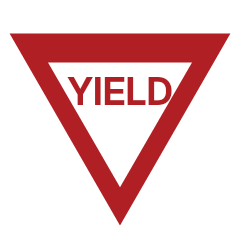
16. A driver passes this sign on an entrance ramp while merging onto a freeway. Who has priority?
Show answer
Answer B: The traffic already traveling on the freeway
The sign places the duty on the entering driver, who must adjust speed and fit into a gap without forcing through traffic to brake or swerve.
-
17. What is wrong with slowing to a crawl at a stop sign and then rolling on through?
Show answer
Answer C: It is not a stop, and you may miss a pedestrian or cross traffic
A rolling stop is a violation and it also cuts short the moment you need in order to look carefully in each direction before entering.
-
18. Why must a tank bag be strapped down properly rather than simply laid on the tank?
Show answer
Answer D: Because a bag that slides can reach the controls or your hands
Braking pushes anything loose on the tank forward toward the handlebars, where it can jam the steering or interfere with the levers.
-
19. You are passing a crash on the other side of a divided highway. What should you do?
Show answer
Answer D: Keep your eyes on your own lane and the traffic around you
Staring at a crash scene, often called rubbernecking, causes sudden slowing and secondary collisions. Your attention belongs on the traffic in front of you.
-
20. About how far ahead do low beam headlights let you see on a dark road?
Show answer
Answer B: About 250 feet
Low beams light roughly 250 feet of road, and high beams roughly 350 to 500 feet, which sets the limit on a safe night speed.
-
21. Traffic is heavy and you find yourself riding level with a car in the next lane. What is the problem with staying there?
Show answer
Answer B: You sit in the driver's blind spot, so a lane change could hit you
Motorcycles disappear easily in a blind spot, so adjust your speed to ride ahead of or behind the other vehicle instead of beside it.
-
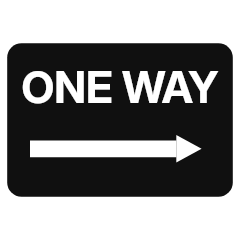
22. Where are signs of this kind placed at an intersection?
Show answer
Answer C: At the near right and far left corners, facing drivers on the intersecting street
They are installed at the corners of the intersecting street so that a driver about to turn in sees the restriction before committing to the turn.
-
23. Enhanced reference location markers differ from ordinary mileposts in that they
Show answer
Answer B: carry the route number and a mileage figure to the tenth of a mile
An enhanced reference location marker adds the route designation and carries the mileage to a tenth, so the point named is far more precise than a plain milepost.
-
24. You are about to pass a long tractor-trailer on a two-lane road. What should you expect?
Show answer
Answer B: You will need more clear road, since the vehicle is much longer
A tractor-trailer can be 70 feet long, so passing it takes more distance and more time than passing a car at the same speed difference.
-
25. Your road ends at a T-intersection with no signs or signals. Who has the right-of-way?
Show answer
Answer A: Traffic on the through road, and you must yield before entering
A driver on a road that ends at a T-intersection must yield to traffic on the through road that continues past the junction.