
North Dakota NDDOT Motorcycle Practice Test 42
- Questions25
- Correct to pass20
- Passing score80%
- Minimum age14 years
-
1. When may a North Dakota driver attend a driver improvement course in lieu of having points entered on the record?
Show answer
Answer C: For violations carrying five points or fewer, once every twelve months
The in lieu of points election is limited to offenses assigned five points or fewer and may be used only once in any twelve-month period.
-
2. You want to pass on a two-lane road where several people are walking on the narrow shoulder ahead. What should you consider?
Show answer
Answer D: There is no escape room if the pass goes wrong, so wait for a better place
A pass depends on having somewhere to go if it goes wrong, and a shoulder occupied by pedestrians removes that option for both vehicles.
-
3. Traffic has built up behind you while you wait for a gap to turn left. How should that affect your decision?
Show answer
Answer C: It should not change it; wait for a gap that is genuinely safe
Pressure from behind does not make a small gap bigger, and rushing a left turn across traffic is a common cause of serious crashes.
-
4. Why may the mirrors and the headlight need readjusting when a passenger is carried?
Show answer
Answer D: Because the added weight changes the angle at which the motorcycle sits
Weight on the rear of the motorcycle raises the front, which aims the headlight and the mirrors higher than the rider intends.
-
5. Below a speed limit sign is a smaller panel with white numbers on a black background and the word NIGHT. What does it show?
Show answer
Answer D: The limit that applies after dark
A night speed limit panel sets a separate legal maximum for the hours of darkness, and its reversed colors mark it as the night figure.
-
6. How many points does North Dakota assign for failing to stop at a railroad crossing?
Show answer
Answer B: 3 points
Failing to stop at a railroad crossing carries 3 points, more than an ordinary traffic control device violation but far from the top of the schedule.
-
7. What is the correct way to apply the front brake when you need maximum braking?
Show answer
Answer C: Squeeze it progressively harder as weight settles onto the front tire
Progressive pressure lets load build on the front tire before the braking force does, so the tire has the grip needed to handle it.
-
8. Which of the four blind spots around a tractor-trailer is the largest?
Show answer
Answer A: The one on the right side of the truck
A truck has no-zones on all four sides, and the right-side blind spot is the largest because it runs back along the trailer and reaches across more than one lane.
-
9. Two vehicles meet on a steep, narrow mountain road with no room to pass. Which driver should back up?
Show answer
Answer C: The driver heading downhill, who has more control while reversing
On a narrow mountain road the vehicle facing downhill yields, because backing uphill gives better control than reversing down a grade.
-
10. On a busy multilane highway, where is the best place to travel?
Show answer
Answer B: In a gap in the traffic, with space open on both sides
Travelling in a gap keeps escape routes open on both sides, while riding alongside other vehicles removes the room you would need to swerve.
-
11. On a highway with mileage-based exit numbering, you have just passed exit 42 and are looking for exit 55. About how far is it?
Show answer
Answer B: Thirteen miles
With mileage-based numbering each exit takes the number of the nearest milepost, so subtracting one exit number from another gives the distance in miles.
-
12. You have driven at 70 mph for an hour and then exit onto a town street. What is the common risk?
Show answer
Answer B: Your sense of speed adapts, so 35 mph feels slow and you drive too fast
After a long stretch at high speed the brain adapts, so town speeds feel unnaturally slow; check the speedometer instead of trusting the feeling.
-
13. You are pulling out of a farm entrance onto a rural highway. What is your obligation?
Show answer
Answer C: Yield to every vehicle already on the highway before you enter the roadway
A driver entering a highway from a private road or driveway yields to every vehicle already on the highway.
-
14. How can loose spokes be found on a spoked wheel?
Show answer
Answer B: By tapping each spoke and listening for a dull sound instead of a clear ring
A correctly tensioned spoke rings when tapped, while a loose one gives a flat, dull note that stands out from the rest of the wheel.
-
15. On dry pavement in good weather, what is the smallest following gap you should keep?
Show answer
Answer A: About three seconds behind the vehicle ahead
Three seconds is the accepted minimum on dry roads in good visibility, and the gap should be longer in poor conditions.
-
16. What offense does a North Dakota driver commit by driving faster than is reasonable and prudent for the conditions?
Show answer
Answer B: Careless driving
Driving at a speed greater than is reasonable and prudent under the conditions makes the driver guilty of careless driving under the basic rule.
-
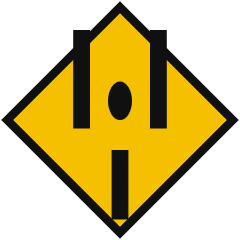
17. Beyond the point this sign refers to, which movement becomes unlawful?
Show answer
Answer D: Driving on the far side of the separation, against the flow
Once the two directions are separated, each roadway carries one-way traffic, so crossing to the other side means driving into oncoming vehicles.
-
18. The added lane warning sign tells a driver that
Show answer
Answer A: an extra lane begins ahead, so entering traffic does not have to merge into an existing lane
Where a lane is added, traffic entering the roadway gets a lane of its own, so merging is not required, although drivers should still watch the vehicles beside them.
-
19. You must cross tracks or pavement seams that run in nearly the same direction as your path of travel. What should you do?
Show answer
Answer C: Move far enough away to cross at an angle of at least 45 degrees, then turn sharply across
A shallow crossing lets the groove catch and steer the front wheel, so the rider sets up to cross at 45 degrees or more and makes one deliberate turn across it.
-
20. With the engine off, a rider turns the handlebars fully to the left and to the right. What is being checked?
Show answer
Answer A: That the steering moves freely and no cable is pinched or binding
Cables and wiring that catch at full lock can hold the throttle open or stiffen the steering exactly when the rider needs a tight turn.
-
21. What should you avoid when a hostile driver pulls alongside you?
Show answer
Answer A: Making eye contact, or answering the gestures in any way at all
Any response, including a look, encourages an aggressive driver, so give none and let the vehicle go.
-
22. A traffic signal is dark and you reach the intersection at the same moment as a vehicle on your right. Who goes first?
Show answer
Answer A: The vehicle on your right, as at any all-way stop
A dark signal is treated as an all-way stop, and the usual tie-breaker then applies: the vehicle on the right goes first.
-
23. Why is it harder to read the road surface at night once it has rained?
Show answer
Answer B: The wet surface throws light away and hides holes and markings
Light from your headlight bounces off wet pavement instead of coming back to you, and reflections of other lights mask the surface, so slow down and open up your following distance.
-
24. Why is it worth planning your route before a long drive?
Show answer
Answer B: So that you are not reading a map or a screen while the car is moving
A driver who knows the route is not navigating at the wheel, which is one of the commonest sources of distraction.
-
25. A clutch cable adjusted with no free play at all causes what problem?
Show answer
Answer B: The clutch may slip and never fully engage
Without a small amount of slack the release mechanism keeps a light load on the plates, so they slip instead of transmitting full power.