
North Dakota NDDOT Motorcycle Practice Test 44
- Questions25
- Correct to pass20
- Passing score80%
- Minimum age14 years
-
1. A shared-use path crosses the road ahead at a marked crossing and people are already crossing on it. What should you do?
Show answer
Answer C: Yield and let them finish crossing the road
People already crossing at a marked crossing have the right of way, and a path crossing is a crossing of the roadway like any other.
-
2. You are turning left from a divided highway through a median opening into a business on the other side. Who has the right of way?
Show answer
Answer C: The traffic on the roadway you are crossing
Turning through a median opening means crossing the opposite roadway, so you yield to all traffic on it before you go.
-
3. How does the distance needed to stop change when a rider doubles speed?
Show answer
Answer D: It grows to roughly four times the original distance
Braking distance rises with the square of speed, so twice the speed needs roughly four times the distance in which to stop.
-
4. You are approaching a blind left hand curve. Which starting lane position gives the best view through it?
Show answer
Answer C: The right portion of your lane
On a left hand bend the outside of the lane is the right side, and moving there lets the rider see farther around the curve before entering it.
-
5. In a staggered group, where does the leader normally ride?
Show answer
Answer B: In the left portion of the lane
The leader takes the left portion of the lane, which gives a wide view of the road ahead and sets up the staggered pattern for everyone behind.
-
6. What is the most common cause of rear-end collisions?
Show answer
Answer C: Following too closely to stop in time
A driver who leaves too little space has no room to perceive, react and brake when the vehicle ahead slows, which is why space management prevents rear-end crashes.
-
7. A row of solid white triangles points toward you across your lane. What does it mark?
Show answer
Answer A: The place to yield to traffic or people ahead
A yield line of triangles shows drivers exactly where to give way, and it is used at roundabouts and at midblock crosswalks.
-
8. Why can a mild afternoon still chill a rider dangerously on the highway?
Show answer
Answer B: Riding speed creates a wind chill well below the air temperature
Air moving over the body at highway speed strips heat far faster than still air, so a comfortable temperature at a standstill can cause serious chilling in an hour of riding.
-
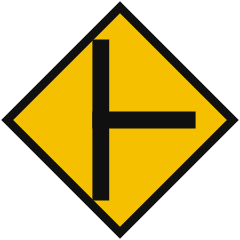
9. What condition does this sign warn a driver about?
Show answer
Answer B: Another road joins the road being traveled, from one side
It announces a side road entering the main roadway, so the driver should expect vehicles waiting to pull out and other vehicles slowing to turn in.
-
10. Why is reflective material more useful than bright color once it is dark?
Show answer
Answer C: It throws headlight light back toward the driver, while color goes unseen
Color needs daylight to be seen, while reflective material returns the beam of an approaching vehicle straight back to its driver.
-
11. How much room should a rider try to leave when passing a line of parked cars?
Show answer
Answer A: Enough to clear an opening door, roughly the width of a car door
A door swings out about the width of a door, so ride at least that far from parked vehicles and slow down wherever you cannot leave that much space.
-
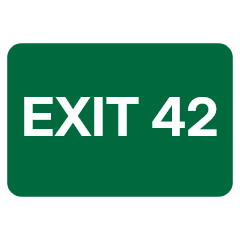
12. A driver in the left lane of a freeway realizes only when level with this sign that the ramp beside it is the one they need. What is the correct action?
Show answer
Answer A: Carry on to the next interchange and turn back from there
There is no safe way back to a ramp once it has been reached from the wrong lane, so the driver keeps going to the next interchange, where the ramps are built for that movement.
-
13. Two vehicles reach a four-way stop at the same moment from adjacent roads. Who should go first?
Show answer
Answer A: The driver on the right
When two drivers stop at a four-way stop at the same time, the driver on the left yields to the driver on the right.
-
14. Which single event causes the largest share of crashes between a motorcycle and another vehicle at intersections?
Show answer
Answer B: A vehicle turning left across the path of an oncoming motorcycle
The classic motorcycle intersection crash is an oncoming driver who turns left across the rider's path, usually after failing to see the motorcycle or misjudging its speed.
-
15. It is hot and a rider wants to ride without gloves. Why is that a poor idea?
Show answer
Answer D: Sweating hands slip on the grips, and bare skin has no protection
Hands go out first in a fall and are hard to repair, and sweaty palms lose their grip on the controls, so wear ventilated summer gloves rather than none.
-
16. What should you do as you approach your exit from a roundabout?
Show answer
Answer A: Signal right and check the crosswalk for pedestrians before leaving
A right signal tells following drivers and waiting drivers that you are leaving, and pedestrians cross at the exit leg, so the crosswalk must be checked.
-
17. You have a green arrow to turn left. What still applies?
Show answer
Answer D: You must yield to any pedestrian or vehicle still inside the intersection
A green arrow protects your turn from conflicting traffic, but you must still let anyone already in the intersection get clear before you move.
-
18. What does a marked crosswalk tell a driver approaching a corner?
Show answer
Answer D: Where pedestrians are expected to cross and must be given way
Crosswalk markings show pedestrians where to cross and warn drivers to yield to anyone using the crossing.
-
19. An overhead sign shows that the right lane is EXIT ONLY. What does that mean if you intend to stay on the highway?
Show answer
Answer B: You have to move out of that lane before the exit
An exit only lane leaves the highway completely, so a driver continuing on the highway has to change lanes before it does.
-
20. A bus stopped at the corner hides the crosswalk you are about to turn across. What should you do?
Show answer
Answer C: Turn slowly, ready to stop for anyone stepping out in front of it
People often step into the road from in front of a stopped bus, so approach the hidden crosswalk slowly and be ready to stop.
-
21. Where must an opened container of alcohol be carried in a North Dakota vehicle that has a trunk?
Show answer
Answer C: In the trunk
An opened receptacle must be kept in the trunk, or in some other area not normally occupied by the driver or passengers where the vehicle has no trunk; a glove compartment counts as occupied space.
-
22. Oil is visible running down the front fork tubes. What does that mean?
Show answer
Answer C: A fork seal has failed and the suspension needs repair
Fork oil escaping past a seal means the front suspension is losing its damping, and the oil can also reach the front brake and ruin its grip.
-
23. A sign reads MINIMUM SPEED 40. What does it require of a driver?
Show answer
Answer C: Not to drive below that speed when conditions allow
A minimum speed limit keeps unnecessarily slow vehicles from obstructing traffic, but it never overrides the duty to slow down for weather or congestion.
-
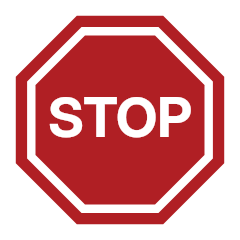
24. A stop line is painted across the pavement at this sign. Where must the vehicle come to rest?
Show answer
Answer A: Behind the stop line, with no part of the vehicle across it
The vehicle must halt behind the stop line; where no line is painted the driver stops before the crosswalk, and where there is neither, before entering the intersection.
-
25. You are on an entrance ramp joining a busy freeway. What should you do with your speed in the acceleration lane?
Show answer
Answer D: Build it up to about the speed of the traffic you are joining
Merging works when your speed matches the traffic stream, because a large speed difference forces the drivers already on the freeway to brake or swerve.