
North Dakota NDDOT Permit Practice Test 3
Test 3 of 10. Pick an answer for each question to see if it is right and why; your score appears at the end. You need 20 correct answers to pass, the same ratio as the real North Dakota test.
- Questions25
- Correct to pass20
- Passing score80%
- Minimum age14 years
-
1. You are turning left from a two-way street onto another two-way street. Where should you begin and end the turn?
Show answer
Answer B: Begin in the lane just right of the center line and finish just right of the center line of the new street
You approach a left turn from the lane closest to the center line and enter the new roadway just to the right of its center line, which keeps you clear of oncoming traffic.
-
2. Visibility drops suddenly and you decide to leave the highway. What is the safest way to do it?
Show answer
Answer A: Take the next exit or a wide pull off, well clear of the traffic lanes
Get right off the traveled way, and off the shoulder too if you can, because vehicles in poor visibility often drift onto the shoulder.
-
3. On a North Dakota highway posted above 65 miles per hour, how is the speeding fee calculated?
Show answer
Answer A: Five dollars for each mile per hour over the limit, or twenty dollars, whichever is greater
On roads posted above 65 miles per hour the fee is five dollars for each mile per hour over the limit or twenty dollars, whichever is greater, against three dollars per mile per hour elsewhere.
-
4. How long may a new North Dakota resident keep driving on an out-of-state Class D or M license?
Show answer
Answer C: 60 days after becoming a resident
North Dakota allows 60 days after residency to obtain a state Class D or M license, while operators of Class A, B or C vehicles have only 30 days to obtain a North Dakota commercial driver license.
-
5. Where is a U-turn generally the most reasonable choice?
Show answer
Answer B: At an intersection where it is permitted and you can see well both ways
A U-turn needs a legal place and a long clear view in both directions, which is why a permitted intersection with open sight lines is the usual choice.
-
6. You are in the middle lane of a one-way street with three lanes when a police car approaches from behind with lights and siren. What should you do?
Show answer
Answer C: Pull to the nearest curb and stop clear of the lanes
On a one-way street you clear to whichever curb is closest, so the emergency vehicle gets a clear path down the open lanes.
-
7. When does a North Dakota restricted Class D license become unrestricted?
Show answer
Answer A: At age 16
North Dakota converts the restricted Class D operator's license to an unrestricted license at age 16.
-
8. Unless otherwise posted, what is the maximum speed limit on North Dakota paved and divided multi-lane highways that are not Interstates?
Show answer
Answer D: 70 mph
North Dakota sets 70 mph on paved and divided multi-lane highways unless otherwise posted, below the 80 mph maximum used on rural Interstates.
-
9. Does North Dakota's wireless communications device law cover entering a destination into a navigation system?
Show answer
Answer A: No, navigation device use is excluded from the definition of an electronic message
The statutory definition of an electronic message expressly excludes inputting, selecting or reading information on a global positioning system or other navigation device.
-
10. What speed limit does North Dakota place on a vehicle running on solid rubber tires?
Show answer
Answer A: 10 miles per hour
North Dakota sets a special maximum of 10 miles per hour for a vehicle equipped with solid rubber tires.
-
11. When should you turn on your signal before a turn or a lane change?
Show answer
Answer C: Well before the maneuver, so other drivers have time to react
A signal is a warning to others, so it has to be given far enough ahead of the maneuver that drivers and pedestrians can adjust.
-
12. At a four-way stop another driver pulls out ahead of you when it was clearly your turn. What is the correct response?
Show answer
Answer B: Let that driver go through, then take your turn when the way is clear again
Right of way is something you give, never something you take, so yielding to a driver who takes it wrongly avoids a crash you would otherwise share.
-
13. What alcohol concentration makes a driver under 21 legally under the influence in North Dakota?
Show answer
Answer A: 0.02 percent
North Dakota treats a driver as legally under the influence at 0.08 percent at any age and at 0.02 percent for drivers under 21.
-
14. Why can a motorcycle ahead of you slow down without any warning light showing?
Show answer
Answer B: The rider may slow by downshifting or rolling off
Riders often lose speed by closing the throttle or changing down, which does not switch on the brake light, so watch the machine itself and keep back.
-
15. In which crash must the police always be notified?
Show answer
Answer D: Any crash in which somebody has been injured or killed, whatever the damage
Injury or death always makes a crash reportable, whatever the amount of vehicle damage or the opinions of the drivers.
-
16. A yellow diamond showing two vertical arrows, one pointing up and one pointing down, warns that
Show answer
Answer A: the road ahead carries traffic in both directions
The two-way traffic sign warns that the roadway ahead is not divided and that vehicles will be coming from the opposite direction.
-
17. You approach a North Dakota railroad grade crossing and your view of the track is obstructed. What speed limit applies within 50 feet of the crossing?
Show answer
Answer C: 20 miles per hour
North Dakota presumes 20 miles per hour to be lawful within 50 feet of a grade crossing where the driver's view is obstructed, judged over the last 200 feet of the approach.
-
18. What must a North Dakota driver present about eyesight when renewing a license?
Show answer
Answer A: A vision screening at renewal, or a vision statement no more than six months old
Every renewal applicant must take a vision test at renewal or present a statement of corrected and uncorrected vision from a physician or optometrist obtained within the previous six months.
-
19. A North Dakota driver cannot safely change lanes for an emergency vehicle stopped on the Interstate. What does the law then require?
Show answer
Answer D: Proceed with due caution, reduce speed and hold a safe speed for the conditions
Where moving to a non-adjacent lane cannot be done with due regard to safety and traffic conditions, the driver must instead proceed with due caution at a reduced and safe speed.
-
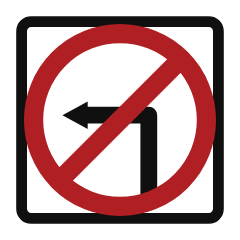
20. No plaque stating days or hours accompanies this sign at the intersection. When does the restriction apply?
Show answer
Answer D: At all times, since nothing limits it to particular periods
A regulatory restriction runs continuously unless a supplemental plaque states the days or hours during which it applies.
-
21. At how many points does North Dakota notify a driver of intent to suspend the license?
Show answer
Answer A: 12 or more
When a North Dakota record reaches a total of 12 or more points, the driver is informed of the intent to suspend and of the right to an administrative hearing.
-
22. A stop line is painted across the pavement at this sign. Where must the vehicle come to rest?

Show answer
Answer A: Behind the stop line, with no part of the vehicle across it
The vehicle must halt behind the stop line; where no line is painted the driver stops before the crosswalk, and where there is neither, before entering the intersection.
-
23. When are you expected to switch from high beams to low beams?
Show answer
Answer D: When a vehicle approaches from ahead or you come up behind another vehicle
High beams blind other drivers, both those coming toward you and those you follow through their mirrors. Dim them whenever another vehicle is within range.
-
24. You are approaching a marked school crossing and children have started to cross the roadway. What is required?
Show answer
Answer A: Stop and let the children finish crossing the roadway
Drivers give way to people in a marked crossing, stopping if that is what it takes, and children in particular may change direction without warning.
-
25. On a North Dakota license, what does the standard restriction numbered 4 require?
Show answer
Answer D: Special hand controls
North Dakota numbers its standard license restrictions, and restriction 4 marks a driver who must use special hand controls.