
North Dakota NDDOT Permit Practice Test 9
Test 9 of 10. Pick an answer for each question to see if it is right and why; your score appears at the end. You need 20 correct answers to pass, the same ratio as the real North Dakota test.
- Questions25
- Correct to pass20
- Passing score80%
- Minimum age14 years
-
1. What happens after North Dakota cancels a minor's permit or license?
Show answer
Answer A: The driver is treated as never having held one and must start the whole process again
A cancelled minor is deemed never to have held a permit or license, so the knowledge test, the vision test, parental permission, a new instruction permit with its holding period and driver education must all be completed again.
-
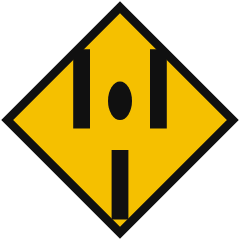
2. What should a driver do first after passing this sign?
Show answer
Answer A: Move into the right-hand lane and stay there
Traffic returns to two-way operation, so the driver keeps to the right of the centerline and stops treating the left side as available.
-
3. The school bus stop ahead sign is installed where
Show answer
Answer C: a school bus stop cannot be seen from far enough away by approaching drivers
This school warning sign is used in advance of a bus stop that lacks adequate sight distance and cannot be relocated, so drivers are warned before the stopped bus comes into view.
-
4. You are using the parking brake to slow a vehicle whose brakes have failed. How should you apply it?
Show answer
Answer D: Gradually, holding the release so you can let it off if the rear slides
The parking brake works on two wheels only, so applying it hard can lock them and spin the vehicle. Keep the release held so you can back it off instantly.
-
5. You are descending a long steep grade with a loaded truck close behind you. What should you do?
Show answer
Answer A: Hold a steady speed and let it pass when it can
Gravity pushes a loaded truck downhill and it cannot slow quickly, so give it a predictable speed and room to get by rather than braking in front of it.
-
6. Federal law lets a state open its high-occupancy vehicle lanes to certain vehicles carrying only one person. Which of these is covered by that allowance?
Show answer
Answer B: Motorcycles
Federal law lets states allow motorcycles into high-occupancy vehicle lanes regardless of the number of occupants, because keeping riders in the flow is safer than the alternative.
-
7. Which violations will a North Dakota driving record disclose to an insurance company checking it?
Show answer
Answer C: Violations within the last three years carrying a point total of three or more
NDDOT states that an insurance company checking a record will see violations within the last three years that carry a point total of three or more.
-
8. What offense does a North Dakota driver commit by driving faster than is reasonable and prudent for the conditions?
Show answer
Answer B: Careless driving
Driving at a speed greater than is reasonable and prudent under the conditions makes the driver guilty of careless driving under the basic rule.
-
9. Within what distance must a North Dakota driver dim the headlights for a vehicle being followed?
Show answer
Answer A: 300 feet
Low beams must be used within 300 feet of a vehicle being followed, while the duty to avoid glaring an oncoming driver begins at 500 feet.
-
10. How can a North Dakota driver tell that a license or identification card is REAL ID compliant?
Show answer
Answer B: A gold star appears in the top right corner
NDDOT states that a North Dakota license or identification card is REAL ID compliant when it carries a gold star in the top right corner.
-
11. You pull onto a soft grass verge to park. What is the main risk?
Show answer
Answer A: The wheels can sink and the car can slide toward the ditch
Soft ground gives way under the weight of a vehicle, and a car that settles or slides sideways can end up stuck or in the ditch.
-
12. What penalty does North Dakota attach to failing to comply with a work zone speed limit while work is in progress and workers are present?
Show answer
Answer A: An $80 minimum fee
North Dakota sets an $80 minimum fee for failing to comply with work zone speed limits when work is in progress and workers are present.
-
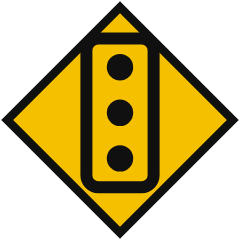
13. What does this sign require of the driver?
Show answer
Answer D: Reducing speed and being ready to stop at the intersection ahead
The advance notice asks the driver to slow and be ready to stop, while whether a stop is actually needed depends on the indication displayed on arrival.
-
14. A truck ahead of you is spreading salt or grit on the road. What should you do?
Show answer
Answer B: Drop back so the material does not reach your car
Spreaders throw material backward and sideways, and following close means stone chips and a screen full of spray, so leave extra distance.
-
15. A pedestrian starts to cross against a Do Not Walk signal, right in front of you. What should you do?
Show answer
Answer D: Slow or stop and let the person reach safety
Even when a pedestrian is crossing unlawfully, a driver must take reasonable care to avoid hitting that person.
-
16. A yellow diamond shows a car with wavy lines behind its rear tires. What is the warning?
Show answer
Answer D: The surface loses grip badly when it is wet
The slippery when wet sign marks a stretch where traction falls off sharply in rain, so speed and braking must be reduced well in advance.
-
17. What cash deposit does North Dakota accept instead of an SR-22 filing after an uninsured reportable crash?
Show answer
Answer A: $25,000 in cash or negotiable securities
Proof of financial responsibility may be shown by filing an SR-22 form or by depositing cash or negotiable securities of $25,000.
-
18. Along a highway the reference markers count upward as you travel. Where does the numbering normally begin?
Show answer
Answer C: At the southern or western edge of the state
Mileage numbering starts where the route enters the state from the south or the west, so rising numbers tell a driver which way they are heading.
-
19. A police car is stopped at the scene of an emergency on an ordinary two-lane North Dakota street with its lights flashing. What must an approaching driver do?
Show answer
Answer B: Move to the right-hand edge of the roadway and stop, then pass at own risk when clear
Approaching traffic must move to the right-hand edge or curb and stop; having stopped, a driver may then pass the scene at their own risk when the roadway is clear, unless an officer directs otherwise.
-
20. Who may sit in the front seat while a North Dakota instruction permit holder is driving?
Show answer
Answer C: Only the supervising driver, unless the vehicle has no seats other than the front seat
Nobody other than the supervising driver and the permit holder may be in the front seat, and if the vehicle has only a front seat the supervising driver must sit next to the permit holder.
-
21. Where are children in the greatest danger around a school bus?
Show answer
Answer B: In the roadway right around the bus, especially in front
The danger zone is the band of roadway around the bus where the driver's view is poorest, and children crossing in front of the bus are hardest to see.
-
22. What statutory fee does North Dakota set for failing to yield to an authorized emergency vehicle?
Show answer
Answer B: Fifty dollars
The fee schedule sets fifty dollars for a violation of the section requiring drivers to stop or yield for an authorized emergency vehicle.
-
23. What minimum light transmittance does North Dakota require through a tinted front windshield?
Show answer
Answer C: 70 percent
Any material or tinting on the windshield must leave a light transmittance of at least 70 percent, against 35 percent for other windows; the area above the AS-1 line or the top five inches is exempt.
-
24. What statutory fee does North Dakota set for using a wireless communications device to handle an electronic message while driving?
Show answer
Answer B: One hundred dollars
The fee schedule sets one hundred dollars for a violation of the wireless communications device section, five times the ordinary moving violation fee.
-
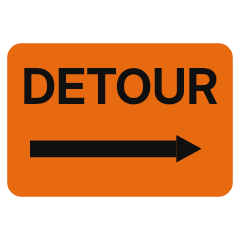
25. Once a driver has joined the route this sign begins, how is the rest of the way marked?
Show answer
Answer B: By further markers of the same kind at each turn, until the original road is rejoined
The alternate route is signed continuously, with a marker at every turn, so a driver with no local knowledge can follow it back to the original road.