
North Dakota NDDOT Motorcycle Practice Test 1
Test 1 of 6. Pick an answer for each question to see if it is right and why; your score appears at the end. You need 20 correct answers to pass, the same ratio as the real North Dakota test.
- Questions25
- Correct to pass20
- Passing score80%
- Minimum age14 years
-
1. Which statement about standard drinks is correct?
Show answer
Answer C: A standard serving of beer, of table wine and of distilled spirits each contain about the same amount of pure alcohol
Roughly 12 ounces of regular beer, 5 ounces of table wine and 1.5 ounces of 80 proof spirits each contain about the same amount of pure alcohol, so the type of drink does not change the effect.
-
2. What statutory fee does North Dakota set for failing to yield to an authorized emergency vehicle?
Show answer
Answer B: Fifty dollars
The fee schedule sets fifty dollars for a violation of the section requiring drivers to stop or yield for an authorized emergency vehicle.
-
3. You are in the acceleration lane and the gap you were aiming for is now beside you. What is the best adjustment?
Show answer
Answer A: Change your speed a little to line up with a gap, then merge smoothly
The acceleration lane is for matching both the speed and the position of a gap, and small speed adjustments are what line the two up.
-
4. A group in formation needs to change lanes. What is the safest way to do it?
Show answer
Answer A: The leader starts the change early enough for the whole group to complete it
Beginning the change early gives the entire formation the road and the time it needs to move over together instead of scattering across two lanes.
-
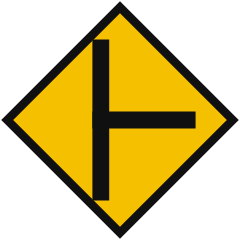
5. Approaching the point this sign refers to, which hazard is most likely?
Show answer
Answer A: A vehicle pulling out from the entering road into the driver's path
The main risk is a driver on the entering road who misjudges the gap and pulls out, so covering the brake and being ready to slow is the sensible response.
-
6. What speed limit applies when passing a North Dakota school during recess or while children are arriving or leaving?
Show answer
Answer A: 20 miles per hour
Unless local authorities designate and post something lower, 20 miles per hour applies when passing a school during recess or while children are going to or leaving school at opening or closing hours.
-
7. How does North Dakota define a motorized bicycle for licensing purposes?
Show answer
Answer D: Two or three wheels no more than 32 inches wide, foot pedals or footrests, an automatic drive system, and displacement no greater than 49.98 cc with a top speed of 30 mph
North Dakota defines a motorized bicycle as a two- or three-wheeled vehicle no more than 32 inches wide with foot pedals or footrests, an automatic drive system requiring no clutch, and a maximum displacement of 49.98 cubic centimeters enabling a speed no greater than 30 mph.
-
8. Does North Dakota's wireless communications device law cover entering a destination into a navigation system?
Show answer
Answer A: No, navigation device use is excluded from the definition of an electronic message
The statutory definition of an electronic message expressly excludes inputting, selecting or reading information on a global positioning system or other navigation device.
-
9. What statutory fee does North Dakota set for using a wireless communications device to handle an electronic message while driving?
Show answer
Answer B: One hundred dollars
The fee schedule sets one hundred dollars for a violation of the wireless communications device section, five times the ordinary moving violation fee.
-
10. Unless otherwise posted, what is the maximum speed limit on North Dakota paved and divided multi-lane highways that are not Interstates?
Show answer
Answer D: 70 mph
North Dakota sets 70 mph on paved and divided multi-lane highways unless otherwise posted, below the 80 mph maximum used on rural Interstates.
-
11. After a reportable North Dakota crash in which the driver had no proof of insurance, how long must proof of financial responsibility stay on file?
Show answer
Answer D: One year from the date of the crash
NDDOT requires proof of financial responsibility, such as an SR-22 filing or a deposit, to be kept on file for one year from the date of the crash.
-
12. What does North Dakota's statewide wireless communications device law forbid an adult driver in traffic from doing?
Show answer
Answer C: Composing, reading or sending an electronic message
The statewide ban reaches composing, reading or sending an electronic message; a voice call or a hands-free use of the device falls outside it.
-
13. You are leaving a private driveway and entering a public street. What are you required to do?
Show answer
Answer B: Stop and yield to traffic on the street and to pedestrians on the sidewalk
A driver entering a roadway from a driveway, alley or private road must stop and yield to traffic on the roadway and to pedestrians on the sidewalk being crossed.
-
14. Which stranded vehicles does North Dakota's Move Over rule cover?
Show answer
Answer A: Any vehicle stranded with flashing hazard lights on an Interstate or multi-lane highway outside city limits
North Dakota extends the duty to yield and move to the non-adjacent lane to any motor vehicle stranded with flashing hazard lights along an Interstate or multi-lane highway outside city limits.
-
15. What cash deposit does North Dakota accept instead of an SR-22 filing after an uninsured reportable crash?
Show answer
Answer A: $25,000 in cash or negotiable securities
Proof of financial responsibility may be shown by filing an SR-22 form or by depositing cash or negotiable securities of $25,000.
-
16. Your green left-turn arrow goes out and a steady green ball stays lit. What may you do?
Show answer
Answer A: Continue turning left, but only after yielding to oncoming traffic
When the arrow ends and a green ball remains, the turn changes from protected to permissive, so it is still allowed but oncoming traffic goes first.
-
17. Your vehicle has antilock brakes. What should you never do in an emergency stop?
Show answer
Answer A: Pump the pedal up and down
The system already releases and reapplies the brakes many times a second. Pumping the pedal interrupts it and makes the stop longer.
-
18. The green arrow protecting your turn changes to a steady yellow arrow. What is it telling you?
Show answer
Answer A: The protected turn is ending and you should prepare to stop
A steady yellow arrow warns that the arrow movement is being terminated and that a red indication will follow.
-
19. Why is repeatedly changing lanes to work through heavy traffic a poor idea?
Show answer
Answer A: It raises the crash risk and saves almost no time
Each lane change adds a conflict with another vehicle, and in congestion the lanes move at similar average speeds, so the gain is negligible.
-
20. On the Interstate system, what do the odd-numbered one and two digit routes have in common?
Show answer
Answer D: They run mainly north and south
Odd numbers are given to north and south Interstates and even numbers to east and west ones, with the numbers rising toward the north and the east.
-
21. What extra penalty does North Dakota attach to driving under the influence with a minor in the vehicle?
Show answer
Answer C: Up to one year imprisonment and a fine of up to $2,000
NDDOT lists a penalty of up to one year imprisonment and a fine of up to $2,000 for driving under the influence with a minor in the vehicle.
-
22. What should a passenger be told about moving around on the motorcycle?
Show answer
Answer A: To stay directly behind the operator and avoid sudden or unnecessary movement
Unexpected movement by a passenger upsets the balance of the machine, most of all at low speed and while the motorcycle is leaned over in a turn.
-
23. What engine size limit applies to North Dakota motorcycle operators aged 14 or 15?
Show answer
Answer C: 510 cc or less
North Dakota limits motorcycle operators aged 14 or 15 to machines with an engine of 510 cubic centimeters or less, both on the permit and on the license.
-
24. Where is the oil and grease strip in a lane usually widest and most slippery?
Show answer
Answer D: At toll plazas, bus stops and intersections where vehicles sit and idle
Oil and coolant drip most where vehicles stop, idle and pull away, so the center strip is widest and slickest at toll booths, bus stops and busy intersections.
-
25. By how much may the speed limit be reduced between two signs posted in a North Dakota highway construction zone?
Show answer
Answer A: No more than 30 miles per hour
The ordinary cap on a reduction between two signs is 20 miles per hour, but in a highway construction zone the reduction may go as far as 30 miles per hour.